Cyber-Y2K · shrunken through the body, cropped at the high hip, worn with the matching pant
Velour Track Jacket (Set, 1 of 2)
PixelVelour
300 GSM cotton velour, 6 cm stand collar with contrast piping, full-length zip, 56 cm chest, 58 cm length, 4 cm rib hem and cuffs. Pairs with velour-track-pant-set
FRONT
BACK
Free vector flat
No account
The drawing above, front and back, as an editable vector — open it in Illustrator, Figma or Affinity and put your own graphics on it. Measurements aren't on the flat; they're in the tech pack.
Opens your browser's print window — choose "Save as PDF" as the destination.
Starting spec — make a sample before you order in bulk.
New to tech packs? Read how to make one, step by step →Fabric
300
GSM · Extra heavyweight · range 270–340
Cotton velour (knit) — 80% cotton / 20% polyester. Pile height 1.5-2 mm, brushed and sheared one direction. The pile direction IS the spec — see the notes
Trim: 1x1 rib and contrast piping · 95% cotton / 5% elastane rib; 100% polyester piping cord · 300 GSM
What does GSM mean? Read the fabric weight guide →How it's made
Shoulder
Set-in, natural shoulder, 0.5 cm drop — 4-thread overlock, pile seams brushed open with a stiff brush before pressing
Neck
Two-piece stand collar, self-fabric with a knit fusible in the outer ply, contrast piping in the collar seam · rib height: 6 cm · topstitch: None — topstitching crushes velour pile permanently
Closure
Centre-front #5 moulded plastic zip, 56 cm, one-way, zips to the top of the collar · hardware: Tonal puller with a 3 cm woven pull tab
Sleeve hem
4 cm 1x1 rib cuff
Body hem
4 cm 1x1 rib hem. Straight; rib relaxed at 50 cm
Piping
3 mm contrast piping in the collar seam, down both sleeve outseams and around both pocket mouths
Pockets
Two slanted welt hand pockets set above the rib hem, 14 cm openings, piped mouths, mesh bags
Side seams
4-thread overlock
Stitch density spi
12 stitches per inch
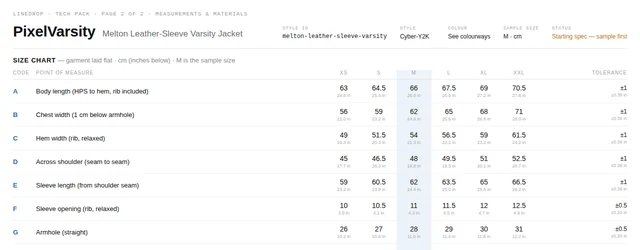
Size chart
Garment laid flat · M is the sample size
Measure
XS
S
M
L
XL
XXL
A
Body length (HPS to hem, rib included)
± 1 cm
55
56.5
58
59.5
61
62.5
B
Chest width (1 cm below armhole)
± 1 cm
50
53
56
59
62
65
C
Hem width (rib, relaxed)
± 1 cm
45
47.5
50
52.5
55
57.5
D
Across shoulder (seam to seam)
± 1 cm
42
43.5
45
46.5
48
49.5
E
Sleeve length (from shoulder seam)
± 1 cm
58
59.5
61
62.5
64
65.5
F
Sleeve opening (rib, relaxed)
± 0.5 cm
10
10.5
11
11.5
12
12.5
G
Armhole (straight)
± 0.5 cm
23
24
25
26
27
28
M
Rib hem and cuff height
± 0.3 cm
4
4
4
4
4
4
O
Collar height (centre back)
± 0.3 cm
6
6
6
6
6
6
Colourways
Chrome Grey / Black
#B9BDC2
Washed Petrol / Bone
#2E4A52
Dusty Rose / Cream
#C08C8C
Trims & notes
• #5 moulded zip 56 cm, one-way
• Woven pull tab 3 cm
• 3 mm filled piping cord, contrast (~400 cm)
• 1x1 rib (cuffs and hem)
• Knit fusible (collar outer)
• Mesh pocketing
• Woven main label
• Care/content label
• Mark the pile direction on every panel and state it on the spec: pile running DOWN the body. Velour cut with panels in opposing directions reads as two different colours under shop lighting, and this is the single most common velour failure — it will pass a fabric inspection and fail the finished garment.
• No topstitching anywhere on the body. Topstitching crushes the pile permanently and leaves a shiny track. The piping is doing the job topstitching normally does, which is why it is in the spec.
• Sample this with the pant, in the same fabric lot. Velour dyes to lot and a jacket and pant from two lots will not match — which is the only thing a customer checks on a set.
• Velour sheds badly on the cutting table. Ask the factory to confirm they will clean down between colours, or the chrome grey will come back with black fibres in the pile.
• Specify the rib as 1x1, not 2x2. A 2x2 rib against a 300 GSM velour body is heavier than the garment and drags the hem down.
More templates like this


© 2026 LineDrop · Starting specs — always make a sample first.