Cyber-Y2K · regular through the chest, sitting at the hip, with the rib pulling the hem in
Melton Leather-Sleeve Varsity Jacket
PixelVarsity
650 GSM wool melton body with 1.0-1.2 mm hide sleeves, 7 cm rib collar, 5 snap placket, 62 cm chest, 66 cm length, 6 cm rib hem and cuffs, slanted welt pockets
FRONT
BACK
Free vector flat
No account
The drawing above, front and back, as an editable vector — open it in Illustrator, Figma or Affinity and put your own graphics on it. Measurements aren't on the flat; they're in the tech pack.
Opens your browser's print window — choose "Save as PDF" as the destination.
Starting spec — make a sample before you order in bulk.
New to tech packs? Read how to make one, step by step →Fabric
650
GSM · Extra heavyweight · range 580–750
Wool melton — 70% wool / 30% polyester. Milled and cropped, piece-dyed. Below 580 GSM the body goes limp and the jacket reads as a cheap fleece bomber; above 750 the armhole will not sew cleanly at 100 units
Trim: Sleeve hide · Cowhide, drum-dyed, 1.0-1.2 mm (alternative: PU-coated poly, 0.9 mm) · 0 GSM
What does GSM mean? Read the fabric weight guide →How it's made
Shoulder
Set-in, natural shoulder, 1 cm drop — Melton seams pressed open and taped; hide sleeve set in with a 2.5 mm needle and a roller foot, no overlock on the hide
Neck
2x2 rib stand collar, two-ply, knitted to shape · rib height: 7 cm · topstitch: None on the collar — a topstitched rib collar loses its roll
Closure
Five 17 mm ring-prong snaps on a 3.6 cm melton placket, both plies fused · hardware: Antique nickel or matte black; specify a 2.5 cm fused reinforcement square behind each snap
Sleeve hem
6 cm 2x2 rib cuff
Body hem
6 cm 2x2 rib hem. Straight; rib relaxed at 54 cm and stretches to the body
Pockets
Two slanted welt hand pockets set above the rib hem, 15 cm openings, bagged in lining
Lining
Full quilted body lining (4 oz wadding, 10 cm channel quilting) and plain taffeta sleeve lining so the arm still slides
Side seams
Melton pressed open and taped; lining bagged out through the sleeve
Stitch density spi
8 stitches per inch
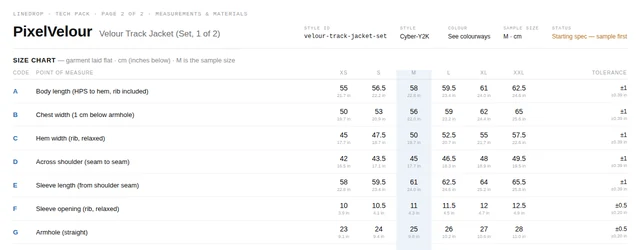
Size chart
Garment laid flat · M is the sample size
Measure
XS
S
M
L
XL
XXL
A
Body length (HPS to hem, rib included)
± 1 cm
63
64.5
66
67.5
69
70.5
B
Chest width (1 cm below armhole)
± 1 cm
56
59
62
65
68
71
C
Hem width (rib, relaxed)
± 1 cm
49
51.5
54
56.5
59
61.5
D
Across shoulder (seam to seam)
± 1 cm
45
46.5
48
49.5
51
52.5
E
Sleeve length (from shoulder seam)
± 1 cm
59
60.5
62
63.5
65
66.5
F
Sleeve opening (rib, relaxed)
± 0.5 cm
10
10.5
11
11.5
12
12.5
G
Armhole (straight)
± 0.5 cm
26
27
28
29
30
31
M
Rib hem and cuff height
± 0.3 cm
6
6
6
6
6
6
O
Collar height (centre back)
± 0.3 cm
7
7
7
7
7
7
Colourways
Black / Bone
#1A1A1A
Deep Navy / Cream
#23314A
Forest / Tan
#2F4634
Trims & notes
• 17 mm ring-prong snaps x5
• 2x2 rib: collar (knit to shape), cuffs, hem
• 4 oz quilting wadding (body lining)
• Taffeta lining (sleeves)
• Fusible (placket, snap reinforcements, welts)
• Woven main label (back neck)
• Care/content label with the hide care warning
• Price the sleeves separately before you commit. Hide at 1.0-1.2 mm is typically 2.5-4x the cost of the PU version and it is the line item that decides whether this garment is viable at your retail price. Ask for both quotes on the same spec sheet.
• The hide sleeve cannot be unpicked. Every needle hole is permanent, so ask for a full sleeve in the sample run and accept that a fit change means a new sleeve, not an alteration.
• The collar rib must be knitted to shape, not cut from rib yardage. A cut-and-sewn rib collar on a 650 GSM body will not stand, and this is the most common varsity sampling failure.
• Do not let the factory overlock the hide. Specify pressed-open seams, a 2.5 mm needle, a roller or Teflon foot and 8 SPI. Overlocked hide perforates along the seam and tears within a season.
• Check the armhole on the sample with the jacket done up. 650 GSM melton against a hide sleeve has almost no give, so a 28 cm armhole that measures correctly flat can still be unwearable — fit it on a person and have them reach forward.
More templates like this


© 2026 LineDrop · Starting specs — always make a sample first.